Correlating Gas Detection and Leak Location
March 2, 2021 · Oliver Heynes
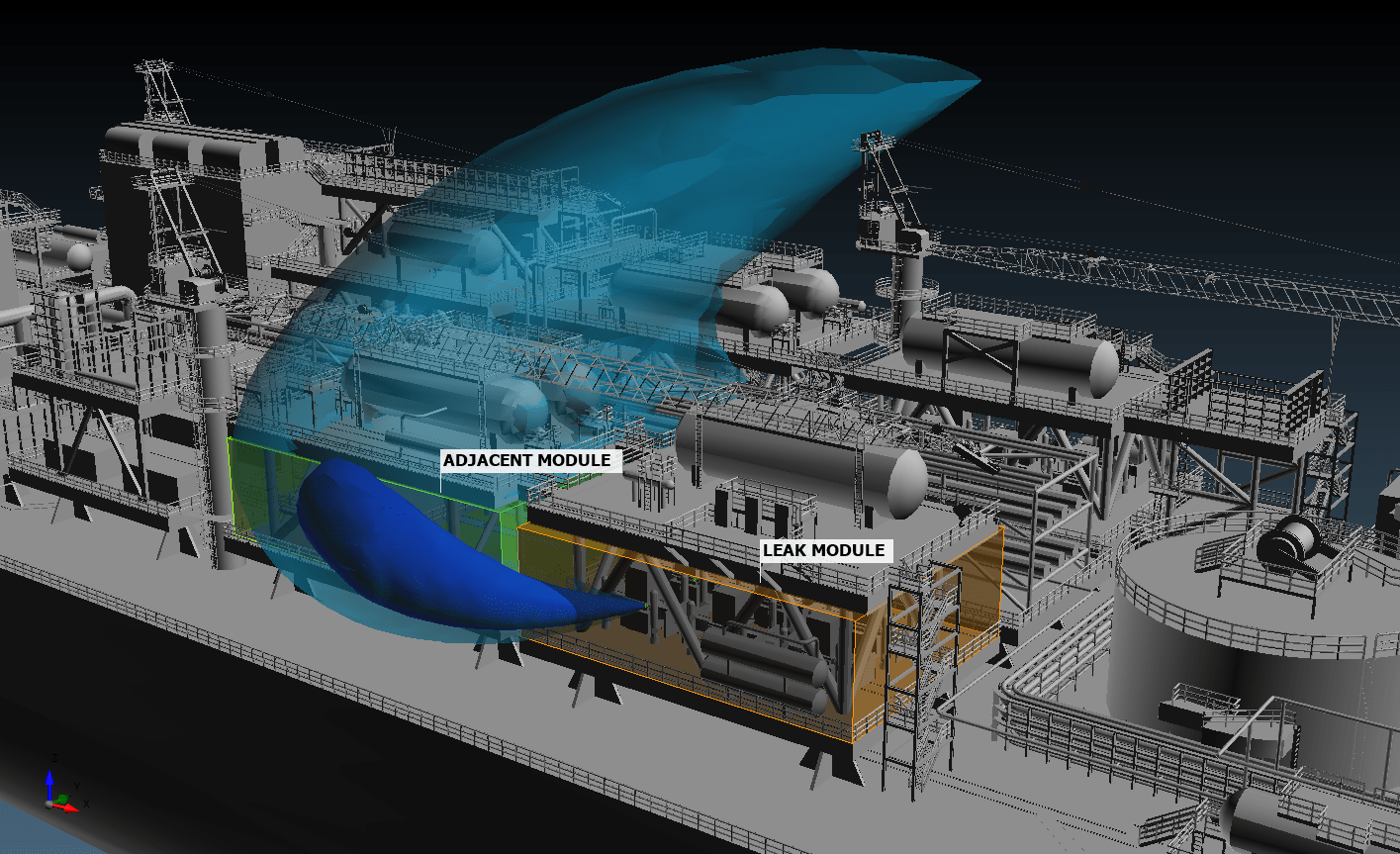
A common assumption implicit in gas detection systems is that a gas cloud is detected in roughly the same location of the leak source. Indeed, many F&G philosophies require a leak to be detected in the same module.
It is clear why this is advantageous – knowledge of the leak location is critical for response planning and automated control actions.
But how accurate is this assumption?
Perhaps less than you think. Consider the simplest case of a leak directed outside of a module. In this case, the size of the detectable cloud is minimal in this module, but in the adjacent modules both the flammable (solid blue in above image) and detectable (transparent blue) cloud is much larger. The gas cloud presents a greater explosion risk in the adjacent module, where the leak is detected.
We can make broad generalizations about how likely this is to occur. The leak sources that would cause such an event are generally close to the perimeter of the module, and the leak direction is any that is away from the center of the module. Roughly speaking, we may be looking at 25% of all leaks.
This number is high. Typically, the coverage requirement for a high-risk module is 80-90%, and if the constraint is imposed that leaks must be detected in the same module, then this requirement may not be achievable.
What are the implications?
- The non-locality of leak source and detection must be considered in a gas mapping analysis. If the constraint that leaks must be detected in the same module, then guidance must be given for leaks directed outside of the module – they are too frequent to simply be ignored.
- Gas detection must consider proximity to high-risk modules. For example, it may be sensible to install flammable gas detectors even on modules that contain no flammable inventory if they are adjacent to high-risk modules. Modules cannot be considered in isolation.
- We must unlearn the lessons from geographic gas mapping, which enforces the idea that detectors must be placed close to potential leak sources. The more we learn from risk-based mapping, the more we see this assumption fall flat.
About the Author: Oliver Heynes
My passion for building intuitive software that brings insight to engineers was fully realized when I co-founded Insight Numerics. Putting CFD to one side, I developed Detect3D, a software program designed to position fire and gas detectors. As well as learning new programming languages, I also learnt that I had a passion for Entrepreneurship and Business Strategy. But my interest in CFD was always present, and in 2015 I envisioned a CFD product for dispersion modeling where the almost the entire process was automated. The vision became reality in 2018 when we released our second software product, in:Flux.