Fire and Gas Mapping in 2021: What to Expect
January 12, 2021 · Oliver Heynes
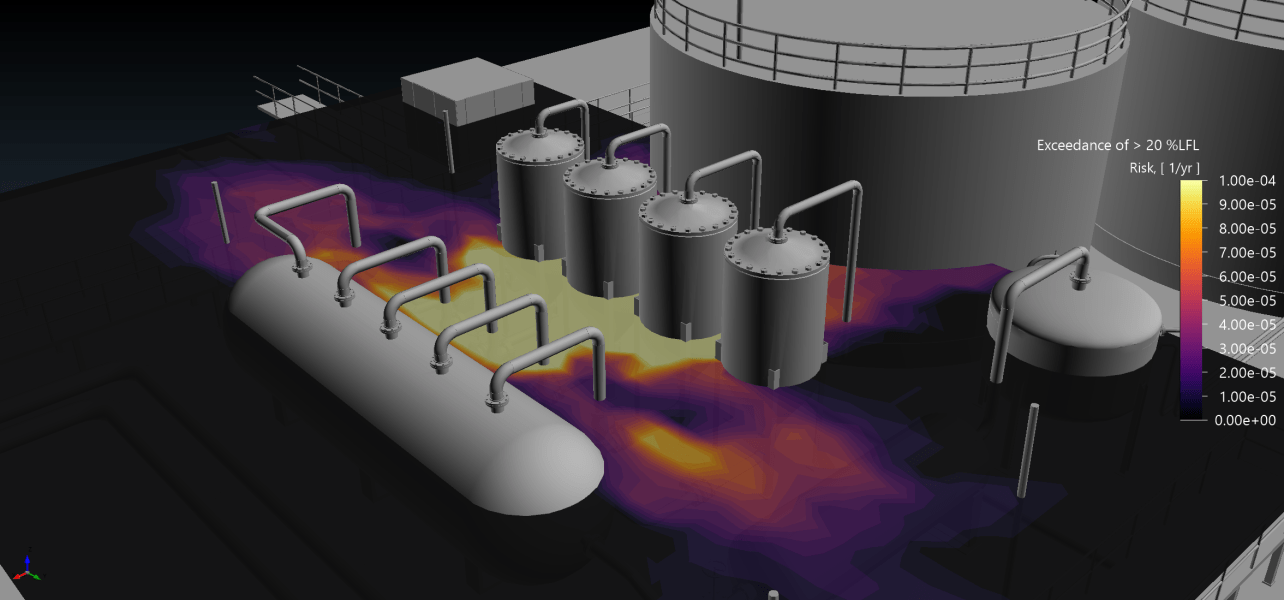
Fire and Gas Mapping is a rapidly developing field, and 2021 will be no different.
In 2020, we saw a significant increase in the number of Risk-Based Gas Mapping projects using in:Flux. It was pleasing to see CFD technology deployed on more and more projects, resulting in detector layouts designed using advanced scientific methods and lowering costs by reducing detector count. This trajectory will continue in 2021.
We will continue to develop in:Flux to cope with the high demands of these projects. At present, it is common for our customers to run several thousand CFD simulations per module, and more than 10,000 CFD simulations per project. We will continue to make Risk-Based Gas Mapping projects easier to run, through better solver performance and automated integration with cloud-based services for distributed computing.
The ease of running thousands of CFD simulations has provided in:Flux users with the ability to start researching interesting topics about Fire and Gas Mapping that have been overlooked in the past. One example is the correlation of leak location and cloud detection – we intuitively consider detection on a module to indicate a leak on that module, but there are many examples of this not being the case. Gas is commonly transported between modules, and quantifying this may lead to important safety improvements in the industry.
What would you like to see from Fire and Gas Mapping in 2021?
About the Author: Oliver Heynes

My passion for building intuitive software that brings insight to engineers was fully realized when I co-founded Insight Numerics. Putting CFD to one side, I developed Detect3D, a software program designed to position fire and gas detectors. As well as learning new programming languages, I also learnt that I had a passion for Entrepreneurship and Business Strategy. But my interest in CFD was always present, and in 2015 I envisioned a CFD product for dispersion modeling where the almost the entire process was automated. The vision became reality in 2018 when we released our second software product, in:Flux.