Why we wrote in:Flux
January 19, 2021 · Oliver Heynes
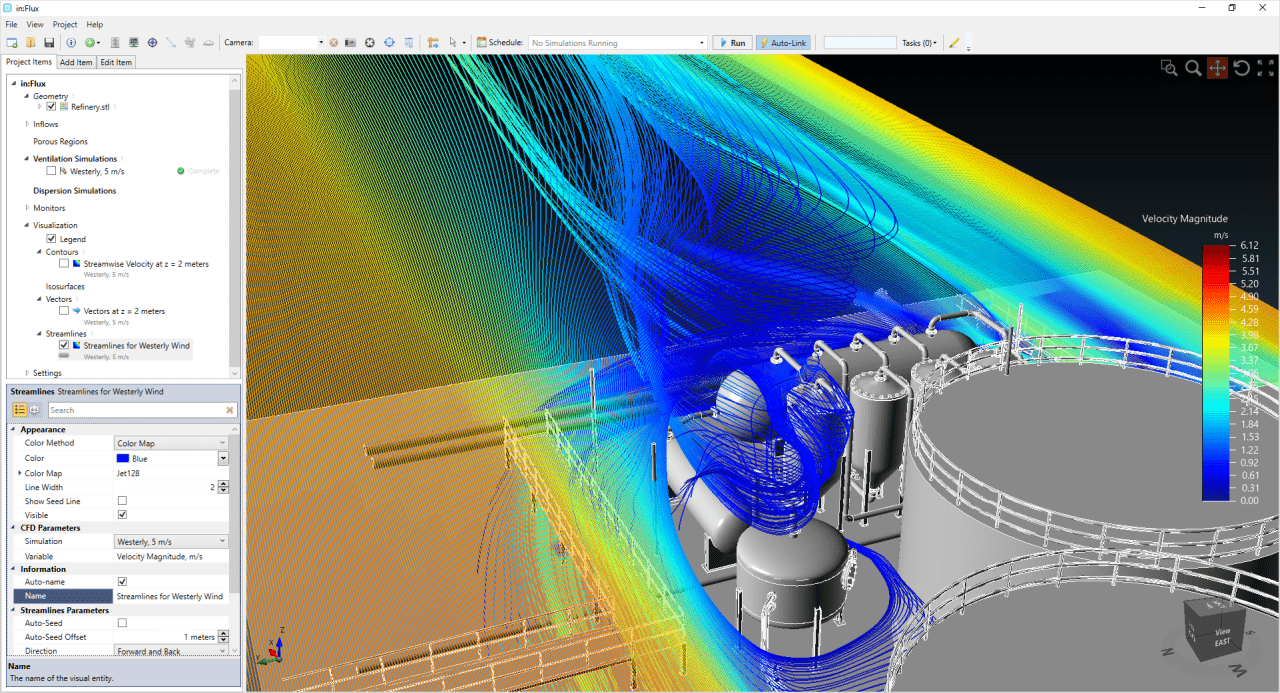
The first time we exhibited in:Flux was at the Hazards 26 conference in Edinburgh, 2016. Our exhibit booth included a monitor showing the alpha version…barely working at the time, but the ideas were there.
“Aren’t you reinventing the wheel?” asked one of the attendees.
“Yes” I replied.
I considered the CFD software that was being used in the safety industry as a wheel that needed reinventing.
As a CFD consultant in the years prior to Insight Numerics, I had experienced first-hand what it meant to use CFD software in our industry. Instead of using the skills I had learnt through my CFD education, I spent most of my time on menial tasks: performing the same kind of meshing over and over again, making simple geometries the software could handle, writing code so that blocks could line up with mesh lines, the list goes on…
I considered the possibility that my experience wasn’t unique. Maybe there were many engineers out there, who also felt held back from effectively applying their expertise purely because CFD software was badly designed and implemented.
This is where the idea for in:Flux came from. Yes, it is CFD software, but that is not the point. It is productivity software. It is meant to enable you, as an engineer, to be as effective as you can be.
We have an upcoming, free webinar where you can learn about in:Flux – sign up if you are interested in the future of CFD in the safety industry.
About the Author: Oliver Heynes

My passion for building intuitive software that brings insight to engineers was fully realized when I co-founded Insight Numerics. Putting CFD to one side, I developed Detect3D, a software program designed to position fire and gas detectors. As well as learning new programming languages, I also learnt that I had a passion for Entrepreneurship and Business Strategy. But my interest in CFD was always present, and in 2015 I envisioned a CFD product for dispersion modeling where the almost the entire process was automated. The vision became reality in 2018 when we released our second software product, in:Flux.